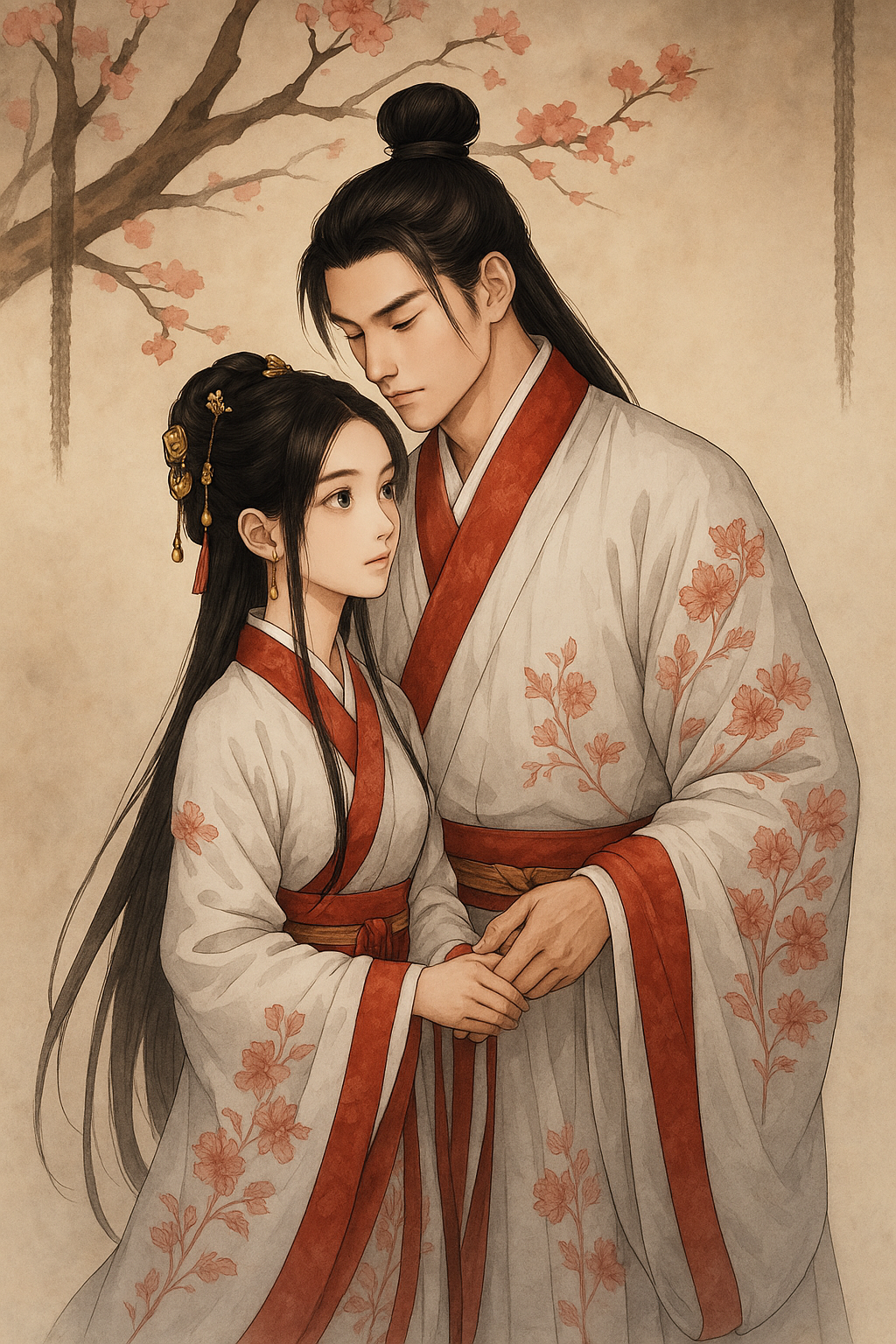
Chapter 109: Zhou Tang (1)
(1)
“Miss! Miss!”
The servants jogged to keep up with their master’s long strides, wiping sweat from their brows as they pleaded, “It’s almost dark! Please go back! The old madam returns to the estate tomorrow, and you haven’t even started copying your assignments!”
Lady Xiangjun was still under house arrest for reflection. If she failed to hand in her work the next day, the punishment would be even more severe—and the servants would suffer alongside her.
“What’s the rush? It’s still early!”
The marketplace was bustling with crowds. Tang Buli, dressed in a crisp, narrow-sleeved military uniform, fiddled with scented pouches and jade ornaments at the stalls, and then grabbed a sugar-coated hawthorn skewer from a peddler’s display. She said idly, “If I really can’t finish it, aren’t you all there to help?”
The servant quickly paid two copper coins to the vendor and said miserably, “That won’t do. Our chicken scratch won’t fool the Grand Madam.”
Just then, a slightly worn bundle suddenly flew out from the side and landed right at Tang Buli’s feet.
“Who threw that without looking?”
Tang Buli, indignant, followed the direction the bundle had come from and saw a well-featured, thinly dressed young scholar being thrown out of a bookstore.
“If our paths differ, then there’s nothing more to say.”
The bookstore owner rolled two walnuts in his hand and sneered, “Our shop doesn’t welcome you. Be off.”
The scholar looked to be just of age, his posture straight. He calmly adjusted his well-worn green scholar’s robe and replied, “You may refuse to lend me books, but you cannot ignore reason. Forging calligraphy to imitate the Sage of Calligraphy is a form of fraud, punishable by law—confiscation of property and three years of hard labor. I refuse to abet wrongdoing, and I am right.”
His words were clear and strong, carrying a sense of uprightness.
The gathered crowd began to murmur, pointing at the bookstore.
The owner’s expression changed slightly.
This scholar often came to the bookstore to borrow and copy books. He had the rare ability to mimic the styles of various calligraphy masters. Seeing this rare talent in the capital, the shopkeeper grew greedy and tried to bribe him with silver to create forgeries for profit.
Who would’ve thought this scholar wouldn’t know what’s good for him? Not only did he refuse, he even exposed the scheme in public!
The shopkeeper clenched his walnuts and gave a look to his assistant. The assistant understood, picked up a rare accordion-bound edition of Six Chapters of Explanation, and discreetly slipped into the crowd.
The shopkeeper’s expression eased slightly as he turned the tables and shouted, “You came to my shop to steal! I showed you mercy because of your talent, but you repay kindness with slander!”
“I did not steal.”
“No? Then what’s this!”
The assistant pulled out a book from the scattered bundle and pointed at the bright red “Ten Thousand Volumes Bookstore” stamp on it. “Caught red-handed—still trying to deny it?”
The scholar frowned. It was clear this book had been planted, but he had no evidence to prove his innocence.
The assistant knew this and became even more brazen, dumping out all the copied manuscripts from the bundle.
Papers fluttered through the air like snow—years of painstaking essays and compositions scattered across the ground and trampled into the dust.
The onlookers let out a collective laugh and, more interested in the drama than the truth, merely watched the scene unfold.
Tang Buli bit into her hawthorn skewer and looked at the scholar, who was crouched down picking up the papers one by one. For some reason, she felt a twinge of sympathy.
She had always been the type to fight for justice. Without hesitation, she called out, “Hey! You clearly stuffed that book in yourself and now you’re accusing someone else? What a sneaky move!”
The assistant’s face changed. “Miss, don’t speak nonsense. Did you actually see—?”
“I saw it with my own eyes!”
As she spoke, she deliberately revealed the command token of the Tang Residence at her waist.
The capital wasn’t large—drop a leaf and it might hit several nobles. Naturally, the assistant recognized that Tang Buli was no ordinary person and shrank back into the crowd, guilt written all over his face.
Tang Buli weighed the sugar hawthorn skewer in her hand and hurled it with full force at the assistant. With a smack, it hit him squarely on the back of the head.
The assistant stumbled and scurried back behind the bookstore owner.
The shopkeeper didn’t dare offend someone of status. He forced a smile, muttered a couple of polite words, and then retreated into the shop. The farce had come to an end. The crowd, no longer entertained, flicked their sleeves and dispersed.
Tang Buli clapped her hands clean and glanced over the worn, slightly short sleeves of the scholar. “You can mimic other people’s handwriting?”
The scholar didn’t reply. He continued methodically picking up the scattered papers.
One piece landed on the toe of Tang Buli’s silken boot. The scholar hesitated, unsure whether to reach for it given the rules of propriety.
Tang Buli bent down, picked up the paper for him, and raised an eyebrow. “Hey, how about we make a deal? You do something for me, and I’ll fund your education and living expenses…”
The scholar looked up, his gaze cool and distant.
“Though poor in possessions, I do not lack ambition.”
He said, “I thank the lady for her help today. But if you seek to use that favor to make me do something unjust, I must refuse.”
So young, yet he acted like a crusty old scholar.
Tang Buli found him amusing. She gave the paper a shake and, looking at the flowing, proper calligraphy on it, said, “Don’t worry, all I need is for you to copy some books. I’ll never ask you to do anything illegal or unethical.”
She brought the scholar back to the Tang Residence and arranged a clean room for him in the backstreet where the servants lived.
“What’s your name?” she asked, arms crossed, fully assuming the air of Lady Xiangjun of the Tang household.
“Zhou Yunqing,” he replied. “The ‘Yun’ meaning to contain, and ‘Qing’ as in a guest minister.”
“A fine name,” she said.
She waved a hand, and a servant hauled in a stack of paper and books nearly a foot thick, slamming them onto the battered desk with a thud that sent dust flying.
These were the assignments and punishments she had accumulated over the past month—completely untouched.
“All this needs to be copied by noon tomorrow…”
Looking at the hefty stack, even with three heads and six arms he’d be hard-pressed to finish in one night. Tang Buli’s conscience stirred, and she reluctantly corrected herself, “Never mind, just copy as much as you can. This is my handwriting…”
On a few lines of the Women’s Precepts written on xuan paper, a large long-tailed turtle had been doodled out of boredom.
“…”
Tang Buli calmly tore off the turtle, balled it up, and tossed it into the wastebasket. “No need to imitate this lady’s masterpieces in painting. Just the handwriting is fine.”
With that, she slapped the paper on the desk and generously added two silver ingots as payment.
The next day.
The very first thing the Grand Madam did after returning from her temple pilgrimage was summon her granddaughter to check her homework.
Dragging her feet reluctantly toward the main hall, Tang Buli was still trying to come up with excuses and wondering anxiously—Zhou Yunqing had made no sound all night. Had he taken the money and run?
Just as she muddled through her thoughts, a servant came rushing in from the side gate, arms full of papers. “It’s done! It’s all been copied, Lady Xiangjun!”
“All of it?” Tang Buli was stunned. Zhou Yunqing had completed a full month’s worth of assignments in just eight hours!
She quickly flipped through the stack—nothing missing, every page accounted for, and the brushwork was indistinguishable from her own. It was like an exact replica.
Even her grandmother couldn’t tell the difference.
Tang Buli felt like she had struck gold.
(2)
Tang Buli had a dream.
In the dream, her grandmother had already passed away. She was left with no one to rely on, and under her aunt’s arrangement, she married into a prominent aristocratic family.
Before the wedding, her aunt and the matchmaker praised the aristocratic son to the skies—he was described as peerless and perfect. Only after the marriage did she discover that the man was nothing but a drunken, lustful fool—fine on the outside, rotten within.
One day, drunk, her husband misspoke and insulted the Regent. He was dragged to the Court of Judicial Review and subjected to punishment, his fate uncertain.
High-status marriages were fraught with political entanglements. A husband’s death was a small matter; dragging the whole family down with him was the real disaster. In the dream, Tang Buli had nowhere to turn and had to set aside her pride to beg the newly appointed Vice Minister of the Court for information.
The high-ranking official sitting above had a familiar, cold face. His deep crimson robe was pristine and wrinkle-free.
Meanwhile, she wore a married woman’s hairpin style, her youthful sharpness and pride worn down by fate like a stone losing its edges.
Two years had passed. Now, she was the one in disgrace.
Tang Buli felt deeply ashamed, biting her lip as she knelt down and humbly pleaded with Zhou Yunqing for mercy. She didn’t want to be implicated by that useless husband. She didn’t want to be cast into the Department of Entertainment as a government slave…
“Your husband’s crime warrants death. The sentence is final.”
The anxiety and pressure in the dream were so vivid. She could feel that cold gaze fixed upon her shoulder, so heavy she couldn’t lift her head.
Then the scene shifted abruptly, blurred fragments flashing by like a spinning lantern.
When the dream grew clear again, Tang Buli was lying tense beneath the dim canopy curtains. Reflected in her determined eyes was that handsome face tinged with a red flush.
“Do you know the punishment for adultery under this dynasty’s law?”
His voice was hoarse, eyes filled with conflict. His mouth recited cold legal codes, but his body responded with blazing passion.
Tang Buli jolted awake, so flustered that her cheeks could probably fry a pancake.
She covered her face, unable to believe what she had just dreamed.
She was married. Her husband had committed a crime and was about to be executed and the family property confiscated. She went to beg the official in charge of the case at the Court of Judicial Review—and that official turned out to be the poor scholar from her household who had been copying books for her. And in the dream, she had even done some shameful things with him…
Tang Buli felt like she had been possessed.
“Ugh! Absolutely shameless!”
She didn’t even know who she was cursing. After lying on her back for a while, her mind began to wander again.
That bookworm Zhou Yunqing was like a cold, emotionless statue—how could he possibly…
But once a seed of curiosity is planted, it soon breaks through the soil and begins to grow.
(3)
As usual, Zhou Yunqing wore that faded bluish scholar’s robe, but it was freshly washed and neatly ironed. Far from looking down and out, he gave off an air of upright elegance, like a man with a bamboo staff and straw sandals walking through the mountains—humble, yet dignified.
He stood with his back to Tang Buli by the wall, on which a huge piece of xuan paper was pasted. With brush in hand, he was vigorously writing a grand, majestic prose essay.
Over a thousand words flowed across the wall in bold strokes—like dragons and snakes dancing, elegant and fierce as startled clouds.
Zhou Yunqing was a quiet, aloof, and frankly dull man. But when immersed in ink and scholarly pursuits, his upright, refined figure seemed to exude boundless energy and brilliance.
He completed the final stroke and stood before the wall of prose, inspecting it like a celestial being gazing down on misty mountain ranges.
That was his world.
He remained standing for a long time. A droplet of ink fell from his brush, blooming into a black plum blossom on the floor tile.
Tang Buli watched in a daze, and the book in her arms slipped out with a loud crash, breaking the stillness of the room.
Zhou Yunqing placed the brush down on the table and gave her a cupped-hand salute.
The brilliance vanished. He returned to his quiet and unassuming self.
“Here. Today’s assignment. I’ll write the reflection by tomorrow.”
Tang Buli picked up the Meanings of the Words assignment from her grandmother, pushed it toward Zhou Yunqing, and casually added a silver ingot on top.
She was quite generous with her silver, but Zhou Yunqing didn’t spare it a single glance. He simply returned to the table, picked up his brush, and began writing again.
Tang Buli didn’t leave. She tilted her head and watched for a while before realizing he was writing a reflection on Meanings of the Words. He completed it in one go, without a moment’s pause or hesitation.
Tang Buli was stunned.
“You don’t even need to look at the book?” she asked.
“Already read it,” Zhou Yunqing replied tersely.
“It’s all in my head.”
He couldn’t afford many books, so whenever he borrowed one, he did his best to memorize it completely. He had long since internalized thousands of texts, knowing them by heart.
“You’re amazing.”
Tang Buli had a candid personality and never withheld praise.
“I have a friend from the women’s quarters who also has a photographic memory. If there’s ever a chance, you two should compete.”
Zhou Yunqing remained focused on writing and didn’t respond.
He had no interest in anything outside books. Only when discussing criminal law did he speak passionately and at length.
Tang Buli couldn’t help her curiosity. Could this boring, humorless man really be the same vice minister from her dream—the one who discarded propriety on the bed?
She propped her chin with one hand and stared at him for a long time before she couldn’t hold back and asked,
“Do you have a wife or a concubine?”
“No,” Zhou Yunqing replied without even looking up.
“Do you have a fiancée or a beloved?”
“No.”
No matter how she asked, he only answered with a flat “No.”
For some reason, Tang Buli recalled that dream again. He didn’t seem like a man of lust—so how could that have happened…?
She cut off the dangerous images, cleared her throat, and asked,
“Then let me ask you something. If a woman’s husband committed a crime and she got implicated, and she went to plead with the judge for leniency, and then…”
She coughed again, stammering under Zhou Yunqing’s puzzled gaze,
“…and then somehow they ended up sleeping together—what would that be considered?”
The moment he heard it was a legal matter, Zhou Yunqing perked up.
“Was the woman willing?”
“I suppose… maybe, yes.”
“Then it’s consensual adultery,” Zhou Yunqing stated seriously.
“According to current law, both parties receive twenty strokes and three years of penal servitude. If she used her body as a bribe and the judge altered the case ruling, the punishment is heavier: dismissal from office and exile a thousand miles away.”
“…”
Tang Buli wasn’t ready to give up.
“What if you were that judge?”
“Impossible.”
This time, Zhou Yunqing answered swiftly and with conviction.
“If I were the judge, I would uphold the law with integrity and throw that bribing woman out the door.”
Tang Buli suddenly felt both stifled and annoyed.
But after holding it in for a while, she didn’t even know where to begin arguing. That dream was fictional after all—she couldn’t treat it as real.
She raised a brow.
“I don’t believe you. You’re really not affected by women at all?”
“No.” Zhou Yunqing answered.
The more he contrasted with the version of him in her dream, the more Tang Buli suspected he was pretending to be aloof.
As a titled lady from Qingping, she was used to mischief and far from well-behaved. Anything she was curious about—she had to get to the bottom of it.
“What about this, then?”
Tang Buli leaned closer over the desk and blew softly at him.
The young noblewoman in crimson military attire had a golden whip and bells hanging from her waist. Pampered and proud, she shone like the scorching summer sun.
Zhou Yunqing’s eyelashes trembled slightly, but his brush didn’t stop.
“And this?” Tang Buli pressed her hand over his.
The scholar’s fingers were long and elegant, with faint calluses from the brush—but they were still very nice to look at.
Zhou Yunqing could no longer continue writing. He lifted his gaze to look at her.
His eyes caught the light, a pale amber shade that, up close, were startlingly clear and sharp.
“And this?”
In a moment of reckless impulse, just like in her dream, Tang Buli quickly pecked him on the cheek.
Rather than a gentle kiss, it was more like she clumsily bumped into him—her nose even ached from hitting his cheek.
The brush dragged a long tail across the xuan paper.
A breeze blew in from the half-open door, rustling the wall of paper. The scent of ink wafted through the air.
Zhou Yunqing froze, his expression calm as still water, but his abdomen tensed abruptly.
Realizing what she had just done, the teasing heat in Tang Buli’s mind vanished, leaving only intense embarrassment.
Their eyes met. The air seemed to freeze.
She jumped to her feet, took a step back, scrubbed at her lips vigorously—then bolted.
Leave a Reply